

Honoring the Past and Shaping the Future: A New Era for Fisheries Research and Development in Sri Lanka
A Comprehensive Tribute to the Visionary Legacy of Prof. H.H. Costa
Emeritus Professor M. J. S. Wijeyaratne
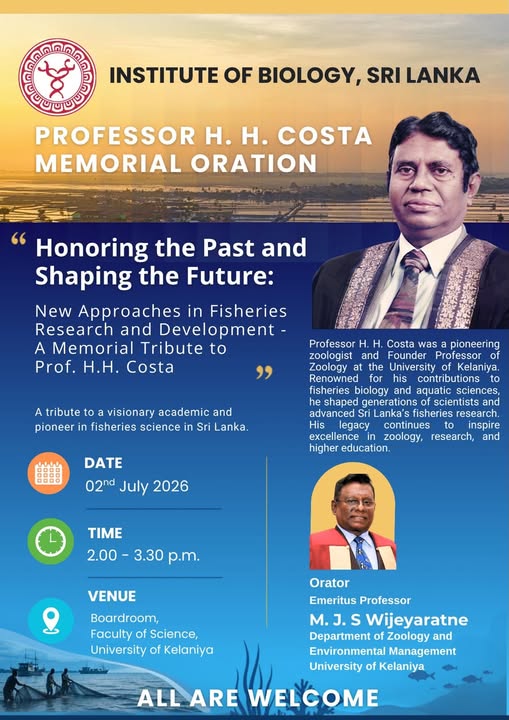
Prof. H. H. Costa Memorial Oration at University of Kelaniya on 2 July 2026
In the annals of Sri Lankan academia and aquatic sciences, few names command as much reverence as that of Professor Henry Hyacinth Costa. He was not merely an educator or an administrator; he was a visionary architect of scientific thought, a relentless champion of research, and a nurturing mentor whose influence ripples through the fabric of Sri Lanka’s fisheries sector even today. As we commemorate his profound legacy, we are compelled to not only reflect on his monumental contributions but also to chart a bold, innovative course for the future of fisheries research and development—a future that must be built upon the strong foundations he laid.
The Architect of a Discipline: The Life and Legacy of Prof. H.H. Costa
Prof. Costa’s career was defined by an unwavering commitment to excellence and a profound belief in the symbiotic relationship between teaching and research. He served as the Founder Head of the Department of Zoology at the University of Kelaniya (then Vidyalankara University) from 1967 to 1980 and again from 1983 to 1989, a total of 20 years of departmental stewardship. His leadership acumen was recognized at the highest level when he was appointed Vice-Chancellor of the University of Kelaniya from 1994 to 1997. In total, he held significant administrative positions for 23 of his 31 years of service, demonstrating a remarkable ability to balance governance with his academic passions.
His influence, however, was not confined to a single institution. He was a Founder Fellow of the National Academy of Sciences (NAS), Sri Lanka, joining an elite cohort of 52 other leading scientists at the nation’s inception. His advisory roles were extensive and impactful, serving on the first Governing Board of the National Aquatic Resources Research and Development Agency (NARA), advising the Ministry of Fisheries, and contributing his expertise to the advisory committees of the Department of National Museums and the Department of Zoological Gardens. He also served as the President of Section D of the Sri Lanka Association for the Advancement of Science (SLAAS) and was a respected examiner for Zoology at the GCE Advanced Level examination. He retired in August 1998 and passed away on December 22, 1998, at the age of 66, leaving behind a void that is still felt.
A Global Scholar and Pioneer of International Collaboration
Long before internationalization became a buzzword in higher education, Prof. Costa was actively building global bridges. In 1970, he initiated the Faculty of Science’s very first international link: the Austrian-Ceylonese Hydrobiological Mission. This collaboration between the First Zoological Institute of the University of Vienna and his own Department of Zoology was a groundbreaking endeavor that brought international expertise and perspectives to Sri Lanka.
Prof. Costa’s own academic journey was punctuated by prestigious international fellowships, which he used to absorb global best practices and bring them home. In 1973, he was awarded a Fulbright Postdoctoral Fellowship to the College of Fisheries at the University of Washington, USA. He followed this with a UNESCO/UNEP scholarship in environmental protection at the University of Dresden, Germany, in 1978, and a Commonwealth Fellowship to the University of London in 1983. These experiences not only enriched his own research but also created a vital network that he generously used to benefit his students.
The Core Philosophy: Research as an Obligation
Prof. Costa was a true disciple of the philosophy espoused by Sir Ivor Jennings, the founder Vice-Chancellor of the University of Ceylon, who in 1942 declared: “A university teacher who is doing no research is not a university teacher. The research is as important as the teaching. It is an obligation, which we owe to the community and to our students. In universities, we are always on the border of knowledge looking into the unknown or at best the partially known. We are not teaching set facts which simply have to be accepted dogmatically. The data of one generation may be rejected by the next.”
Prof. Costa internalized this dictum and made it the cornerstone of his career. His own research was multifaceted, encompassing taxonomy and ecology. His meticulous taxonomic work led to the discovery of two new endemic crustacean species: Caridina fernandoi (Arudpragasam and Costa, 1962) and Machrobrachium srilankense (Costa, 1979). In a testament to his standing in the scientific community, a third species was named in his honor: Caridina costai (de Silva, 1982).
But his greatest research output was not just his own discoveries, but the researchers he produced. His passionate encouragement created a cascade of academic success. Over 25 of his students became professors within the Sri Lankan university system (at the Universities of Kelaniya, Colombo, Ruhuna, Wayamba, Sri Jayewardenepura, and Rajarata) and at overseas institutions like the Asian Institute of Technology (AIT) in Thailand. Many others served as Research Officers in national R&D institutions such as NARA, the Tea Research Institute (TRI), and the Sri Lanka Standards Institution (SLSI), as well as in key Government Departments like the Anti-Malaria Campaign, the Department of Agriculture, and the Department of Fisheries.
One of the most celebrated research projects to emerge from his tutelage was the biological control of the invasive aquatic weed Salvinia using the salvinia weevil, Cyrtobagous salviniae. This highly acclaimed and successful research, conducted by his student Dr. Ivor Fernando, stands as a textbook example of an environmentally friendly and cost-effective solution to a major ecological and economic problem.
The awards garnered by his students are a testament to his mentorship. They have won the Third World Academy of Science (TWAS) Award for best young scientists in Sri Lanka, CVCD Excellence Awards for outstanding researchers, Presidential Research Awards, General Research Awards of the SLAAS, and Research Awards of the National Science Foundation (NSF). Remarkably, the Department of Zoology and Environmental Management at the University of Kelaniya is the only academic department in the entire Sri Lankan university system to count three recipients of the prestigious CVCD Excellence Awards among its faculty—a rare and incredible honor that highlights the world-class research standards set by the progeny of Prof. H.H. Costa.
He was a kind-hearted and selfless mentor who never hesitated to recommend his students for postgraduate programs in reputed foreign universities in the UK, Canada, Germany, and beyond. He was genuinely delighted and proud of their achievements, viewing their success as the ultimate validation of his life’s work.
A Pioneer in Education and Curriculum Development
Beyond research, Prof. Costa was a pioneer in university education. When the Faculty of Science was established in 1967, the first batch of Biological Science students had no Botany classes due to a lack of faculty. Prof. Costa and his staff stepped in to teach Zoology throughout the first year, ensuring the students received a comprehensive education. He was also a champion of experiential learning, introducing field practical classes into the Zoology curriculum. He organized field trips to Beruwala Beach, Negombo beach, Ragama Ihalagama wewa, and other sites, fostering a hands-on, practical understanding of ecology that continues to be a hallmark of the department’s teaching today.
His academic leadership was marked by several “firsts” for the Faculty of Science. He co-supervised the faculty’s very first PhD, collaborating with a world-renowned fisheries scientist from the University of Michigan. He was the first professor in the faculty to supervise a foreign MPhil student (from Malaysia in the early 1980s) and the first to establish a formal research link with a foreign university—his pioneering collaboration with the University of Vienna.
Shaping the Future: New Approaches in Fisheries Research and Development
While we honor Prof. Costa’s legacy by remembering his past achievements, we honor him most profoundly by building upon them. The fisheries sector faces unprecedented challenges and opportunities, demanding a new wave of innovation and sustainable practice. The data paints a clear picture of the landscape ahead.
1. Understanding the Current State: A Statistical Overview
The latest global statistics for 2024 illustrate a world increasingly reliant on aquaculture. Total global production stands at 235 million metric tons (MT), with aquaculture contributing a significant 142 million MT (60.4%) and capture fisheries providing 93 million MT (39.6%).
In Sri Lanka, the situation is more complex. The figures from 2020 to 2025 reveal a dominance of marine capture fisheries, which account for the vast majority of total production. However, there is a concerning trend: total capture fisheries have fluctuated from 411,240 MT in 2020 to 350,885 MT in 2025. While inland capture fisheries and aquaculture have seen some growth in their percentage contribution—rising from 19.7% to 23.9% and 4.1% to 5.5% respectively—they remain a disproportionately small part of the total. This stagnation highlights an urgent need to develop these sectors through research and investment to reduce pressure on marine stocks and ensure food security.
2. The Technology Frontier: Integrating High-Tech Solutions
The future of fisheries will be defined by our ability to harness technology for better management and efficiency.
- Satellite Information & Remote Sensing: While already used to locate fishing grounds, satellite data can be a game-changer for habitat assessment. By analyzing Sea Surface Temperature (SST) and Chlorophyll-a levels (a proxy for phytoplankton abundance), scientists can identify areas of high productivity and predict the movement of fish stocks in response to environmental changes. This is crucial for adaptive management.
- Sensors and Real-Time Monitoring in Aquaculture: This represents a paradigm shift from traditional farming. Deploying a network of sensors in aquaculture ponds allows for real-time monitoring of critical parameters: Temperature, Dissolved Oxygen (DO), Ammonia content, Turbidity, and pH. This data can be analyzed to:
- Predict and Prevent Disease: Early detection of abnormal behavior or water conditions allows for rapid intervention, reducing mortality.
- Automate Feeding: Sensors can detect feeding behavior and stop automatic feeders when fish are satiated, reducing feed wastage, improving Feed Conversion Ratios (FCR), and lowering the risk of water pollution from uneaten food.
- Optimize Aeration: Aeration can be triggered only when DO levels drop below a threshold, conserving significant amounts of electricity.
3. Adapting to Global Climate Change
Global warming is an undeniable reality that will profoundly impact fisheries. As sea surface temperatures rise, many commercially important fish species will be forced to migrate to deeper, cooler waters to find their optimal thermal niches. This shift necessitates a parallel innovation in fishing technology. Traditional gear will become ineffective. New gear designs—such as deeper longlines, specialized bottom trawls, and advanced mid-water trawls—must be developed to reach these new depths without causing excessive habitat damage. Simultaneously, the use of by-catch reduction devices (BRDs) and other selective fishing gear must be rigorously promoted and enforced to minimize the capture of non-target species.
4. Unlocking the Potential of Untapped Resources
Sri Lanka’s EEZ is a treasure trove of underutilized marine life. Scientific research is the key to unlocking this potential sustainably.
- Mesopelagic Fish: The recent survey by the R/V Dr. Fridtjof Nansen revealed rich, untouched stocks of mesopelagic fish (living at 200-1000 m depth). These fish are highly nutritious and rich in Omega-3 fatty acids. They can be harvested for direct human consumption or processed into high-value fishmeal and fish oil. Developing specialized gear like mid-water trawls capable of operating at these depths is a research priority.
- Dogfish Sharks: Currently a small seasonal fishery, the dogfish has immense untapped potential. Beyond fresh and dried consumption, its liver is rich in squalene and can be used to produce fish oil for nutraceuticals and body lotions. The jaws are highly sought after as ornaments, and the fins are used in shark fin soup. The rest of the carcass can be processed into fish meal for the burgeoning aquaculture industry.
- Demersal Fish: The demersal (bottom-dwelling) fishery for high-value species like snappers, carangids, emperors, and groupers is not yet fully developed. A detailed stock assessment is urgently needed to determine the Maximum Sustainable Yield (MSY). With this data, suitable and selective bottom-set gillnets, handlines, and deep-slope traps can be developed. The skins of these fish can also be tanned to produce high-quality “fish leather” for manufacturing handbags, wallets, and belts—an emerging value-added industry.
- Conger Eel: While a seasonal fishery exists in Thalawila, research can help develop it to operate at its MSY. The eel can be consumed fresh or dried, and its swim bladder is a delicacy used in soups.
- Jellyfish: These are exploited seasonally, but there is significant potential for expansion. Present uses include being processed and exported, used as fertilizer, and for collagen production. Future research could explore their potential for human consumption, as bait, for synthesizing natural insecticides, or for pharmaceutical production (anticoagulants, antioxidants).
- Seaweeds: Cultured primarily in the Northern region, seaweed aquaculture has high potential. It is used as human food, animal feed, and plant growth enhancer. It is also a source for extracting dyes, agar, and pharmaceutical compounds (especially in traditional Chinese medicine). Expanding this industry can create coastal livelihoods and contribute to carbon sequestration.
- Oysters: The northwestern coastal region is ideal for culturing the edible oyster Crassostrea madrasensis. Seed is naturally available. Experimental trials have been successful in some western coast estuaries. Community-based aquaculture models can be developed to empower local fishers.
- Artemia: The small-scale Artemia (brine shrimp) culture in the Puttalam area can be significantly expanded. Artemia cysts and biomass are a critical feed source for hatcheries and can be a high-value export commodity.
5. Waste as a Resource: Towards a Circular Economy
The shrimp processing industry generates a significant amount of waste (heads, shells). Instead of discarding this, it can be processed to extract chitin and chitosan—biopolymers with extraordinary industrial and biomedical applications. These include tissue engineering, nanomedicine (for drug and gene delivery), wound healing, stem cell technology, antimicrobial agents, anti-aging cosmetics, and vaccine adjuvants. Establishing a local industry for chitin and chitosan extraction would transform a waste problem into an economic opportunity.
6. Strategic Imperatives for a Sustainable Future
To realize this vision, several research and policy priorities must be addressed:
- Reducing Fish Loss and Waste: Research is needed to develop low-cost, low-tech preservation and storage technologies to reduce post-harvest losses along the supply chain, especially for small-scale fishers.
- Empowering Women: Women play a vital role in the fisheries value chain, particularly in processing and marketing. Digital marketing platforms and training programs can empower women entrepreneurs and increase their economic participation.
- Innovative Farming Systems: Biofloc Technology (BFT) is a sustainable aquaculture system that improves water quality by converting toxic nitrogenous wastes into microbial protein. This reduces the spread of pathogens and provides a supplementary feed source, improving fish health and FCR.
- Culture of Microalgae: Microalgae are rich in bioactive compounds like pigments, antioxidants, and Omega-3 fatty acids. Research should focus on cultivating native microalgae strains to be used as high-value nutraceuticals in human and animal feed.
- Combating IUU Fishing: Illegal, Unreported, and Unregulated (IUU) fishing is a major threat to sustainability. Research and investment in advanced surveillance technology (like Vessel Monitoring Systems, drone surveillance, and satellite tracking) are critical to enforcing regulations and protecting resources.
Conclusion: A Call to Action
Prof. H.H. Costa believed that a university exists on the frontier of knowledge, constantly looking into the unknown. He dedicated his life to exploring that frontier and equipping the next generation to do the same. The challenges facing our fisheries today—from climate change to food security—are complex. But they are not insurmountable.
By embracing new approaches, by investing in technology, by unlocking the potential of our untapped resources, and by adhering to the principles of sustainable management, we can honor the legacy of Prof. Costa. We can ensure that his life’s work was not an ending, but a beginning. His students, and their students, are now the pioneers of the future, ready to lead the way in shaping a prosperous, sustainable, and innovative fishery sector for Sri Lanka. The data of one generation may be rejected by the next, but the commitment to research, the passion for discovery, and the unwavering belief in the power of knowledge to drive progress—these are the timeless values that Prof. H.H. Costa instilled, and they will guide us forward.